
In the fast-paced world of 2026, where demands on our time and attention are constantly escalating, the insidious habit of procrastination remains a formidable adversary for many. It’s that whisper in your ear telling you to check social media one more time, that sudden urge to clean your entire house when a deadline looms, or the inexplicable paralysis that prevents you from starting a crucial task. But what if there were updated, science-backed strategies to not only understand this pervasive challenge but to decisively overcome it and build unstoppable momentum? This article delves into the latest insights and practical approaches for overcoming procrastination strategies in 2026, transforming your approach to productivity, and helping you achieve your most ambitious goals.
Procrastination isn’t merely laziness; it’s a complex psychological phenomenon often rooted in emotional regulation issues. We delay tasks not because we don’t want to do them, but because we want to avoid the negative emotions associated with them – fear of failure, anxiety about the unknown, boredom, or even the discomfort of effort. Understanding this fundamental truth is the first step toward effective mitigation. In 2026, armed with a greater understanding of cognitive biases and behavioral psychology, we have more tools than ever to tackle this age-old problem.
The Evolving Landscape of Procrastination in 2026
The digital age, while offering unparalleled convenience, has also introduced new dimensions to procrastination. Constant notifications, endless streams of content, and the pervasive culture of instant gratification provide fertile ground for distraction. For many, the challenge of overcoming procrastination strategies has become more pronounced due to these environmental factors. However, alongside these challenges, new insights from neuroscience and psychology are offering more targeted and effective solutions. The focus has shifted from simply ‘doing it’ to understanding the underlying mechanisms and developing personalized coping strategies.
Understanding the Root Causes: Beyond Laziness
Before we dive into specific strategies, it’s crucial to reiterate that procrastination is rarely about a lack of discipline or inherent laziness. Research consistently points to emotional regulation as a primary driver. When faced with a task that evokes negative feelings, our brains seek immediate relief, often by diverting attention to something more pleasurable or less demanding. This short-term relief, however, comes at the cost of long-term regret and increased stress. Recognizing this emotional component is vital for developing effective overcoming procrastination strategies.
- Fear of Failure/Success: The anxiety associated with not meeting expectations, or conversely, the pressure that comes with success.
- Perfectionism: The belief that if something can’t be done perfectly, it shouldn’t be done at all, leading to paralysis.
- Lack of Clarity: Unclear goals or overwhelming tasks can make it difficult to know where to start.
- Boredom/Lack of Interest: Tasks that are perceived as mundane or unengaging are easily put off.
- Low Self-Efficacy: A belief in one’s inability to complete a task successfully.
- Temporal Discounting: The tendency to value immediate rewards more than future rewards, making long-term goals seem less appealing.
In 2026, understanding which of these underlying factors is most prevalent for you is key to selecting the most appropriate overcoming procrastination strategies. Self-awareness is your most powerful tool.
Cutting-Edge Overcoming Procrastination Strategies for 2026
The good news is that procrastination is a habit, and like any habit, it can be unlearned and replaced with more productive behaviors. Here are some of the most effective and updated strategies you can implement in 2026 to build momentum and achieve your goals.
1. The Micro-Commitment Method: The Power of Tiny Steps
One of the most potent overcoming procrastination strategies involves breaking down overwhelming tasks into ridiculously small, manageable steps. The goal is to make the initial step so tiny that your brain can’t rationalize delaying it. For instance, instead of ‘write a report,’ your micro-commitment might be ‘open the report document’ or ‘write the title.’ This concept, often linked to ‘Kaizen’ or continuous improvement, leverages the ‘activation energy’ principle. Once you start, even with a tiny step, the inertia is broken, and it becomes easier to continue.
- Identify the smallest possible action: What’s the absolute minimum you can do to get started?
- Commit to just that one step: Don’t think about the whole task, just the first micro-step.
- Leverage the ‘Zeigarnik Effect’: Our brains tend to remember and feel uncomfortable about unfinished tasks, creating an urge to complete them once started.
2. Time Blocking and the Pomodoro Technique 2.0
While not new, time blocking and the Pomodoro Technique remain foundational for overcoming procrastination strategies, and their application has evolved. In 2026, the emphasis is on flexible time blocks and integrating strategic breaks that truly refresh. The classic Pomodoro involves 25 minutes of focused work followed by a 5-minute break. The ‘2.0’ aspect encourages personalization:
- Flexible Intervals: Experiment with 30/10, 45/15, or even 50/10 intervals to find what best suits your concentration span and the task at hand.
- Purposeful Breaks: Instead of mindlessly scrolling, use breaks for active recovery – stretching, walking, meditating, or a quick brain-training game.
- Deep Work Sessions: Schedule longer, uninterrupted blocks (e.g., 90 minutes) for tasks requiring intense focus, followed by a substantial break.
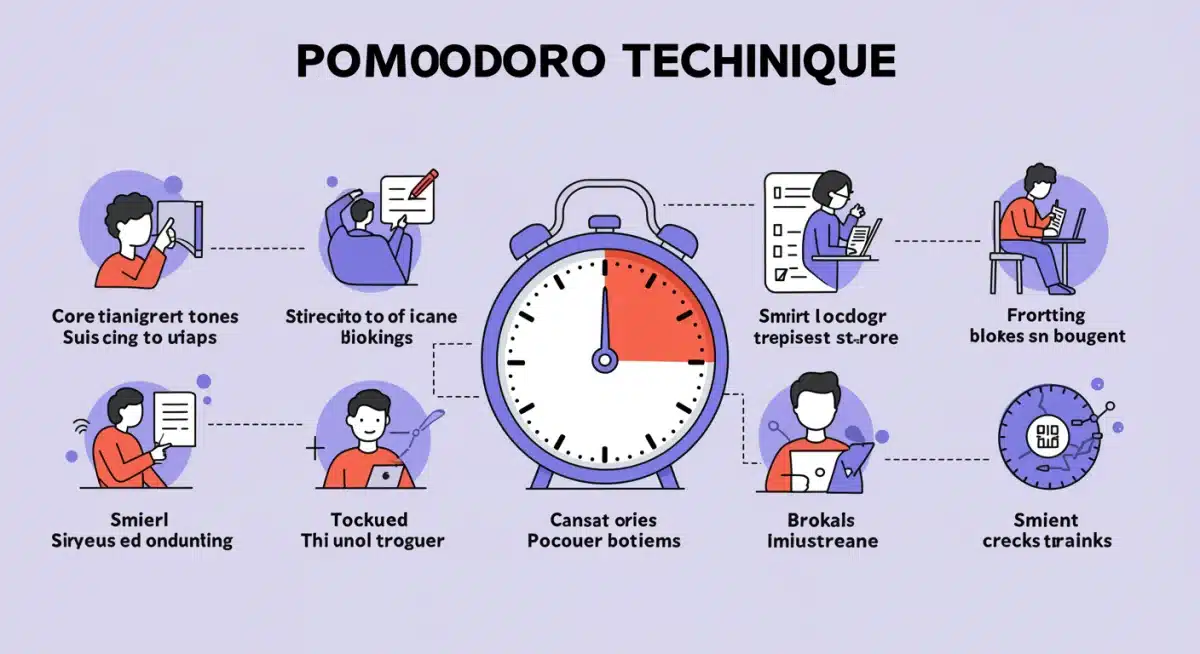
Digital tools in 2026 are highly sophisticated in supporting these methods, offering customizable timers, distraction blockers, and analytics to track your focus periods.
3. The ‘Five-Minute Rule’: Defeating the Initial Resistance
Similar to micro-commitments, the ‘Five-Minute Rule’ is a powerful psychological hack for overcoming procrastination strategies. The premise is simple: commit to working on a dreaded task for just five minutes. Often, the hardest part is starting. Once you’ve invested five minutes, you’ll frequently find that the task isn’t as bad as you imagined, and the momentum will carry you forward. If, after five minutes, you still genuinely can’t stand it, you can stop (though you’ll rarely want to).
4. Habit Stacking and Environmental Triggers
Leveraging existing habits is a highly effective way to introduce new, productive ones. This is known as habit stacking. For example, ‘After I finish my morning coffee, I will spend 15 minutes reviewing my most important task for the day.’ By linking a new desired behavior to an already established routine, you reduce the mental effort required to initiate it. In 2026, this extends to optimizing your environment:
- Remove Distractions: Turn off notifications, close unnecessary tabs, use website blockers.
- Create a Dedicated Workspace: A space solely for work or deep focus signals to your brain that it’s time to be productive.
- ‘Pre-Commitment’ Strategies: Lay out your workout clothes the night before, prepare your lunch in advance, or leave your report open on your desktop.
5. The ‘Future Self’ Connection: Bridging the Empathy Gap
One reason we procrastinate is that we tend to prioritize our ‘present self’ (who wants immediate gratification) over our ‘future self’ (who will benefit from the work done now). In 2026, research emphasizes building a stronger connection with your future self. This can involve:
- Visualizing Success: Regularly imagine the positive outcomes of completing the task – the relief, the achievement, the praise.
- Writing a Letter to Your Future Self: Acknowledge the current struggle and express gratitude for the future self who persevered.
- Setting ‘If-Then’ Plans: ‘If X happens, then I will do Y.’ For example, ‘If I feel the urge to check social media, then I will immediately close the tab and open my work document.’
These strategies help to bridge the ’empathy gap’ and make the benefits of future actions feel more immediate and compelling, thereby strengthening your overcoming procrastination strategies.
Advanced Psychological Hacks for Sustained Momentum
Beyond the immediate starting strategies, maintaining momentum requires a deeper understanding of psychological principles that can be harnessed for long-term productivity.
1. Harnessing the Power of ‘Gamification’
Making tasks feel like a game can significantly boost motivation and make overcoming procrastination strategies more enjoyable. This involves:
- Tracking Progress: Use apps or simple checklists to visibly mark off completed tasks. Seeing your progress provides a sense of accomplishment.
- Setting Small Rewards: Promise yourself a small, immediate reward upon completing a specific segment of a task (e.g., 10 minutes of reading, a favorite snack).
- Creating Challenges: Compete with yourself or a friend to see who can complete a task faster or more efficiently.
Many productivity apps in 2026 incorporate gamification elements, turning your to-do list into a quest.
2. The Role of Self-Compassion and Mindful Awareness
Beating yourself up for procrastinating often leads to more procrastination. Self-compassion – treating yourself with the same kindness you would a friend – is a crucial element of effective overcoming procrastination strategies. When you find yourself procrastinating:
- Acknowledge the Feeling: Instead of judging, simply observe the urge to delay. ‘I’m feeling resistant to starting this task.’
- Practice Self-Kindness: Remind yourself that everyone struggles with this. ‘It’s okay to feel this way, but I can still choose to act.’
- Mindful Action: Gently redirect your attention to the task, focusing on the present moment of doing, rather than the outcome or the perceived difficulty.
Mindfulness practices, increasingly integrated into productivity coaching in 2026, help train your attention and reduce the emotional grip of procrastination.
3. Accountability Systems 2.0: Beyond Just a Friend
Accountability is a powerful external motivator. While telling a friend about your goals is a good start, 2026 offers more robust accountability systems:
- Accountability Partners/Groups: Regularly check in with someone who has similar goals. Share progress, challenges, and celebrate successes.
- Public Commitments: Announce your goals on social media or to a wider audience, creating a stronger incentive to follow through due to social pressure.
- Financial Stakes: Use apps or platforms that charge you money if you fail to meet your self-imposed deadlines (e.g., StickK). The fear of losing money can be a powerful deterrent to procrastination.
4. Rethinking Your Relationship with Failure
Often, procrastination stems from a fear of failure. In 2026, a growth mindset – viewing challenges as opportunities for learning rather than definitive judgments of ability – is paramount. Shift your perspective:
- Embrace ‘Failing Forward’: Understand that mistakes are inevitable parts of the learning process. Each attempt, even if imperfect, provides valuable data.
- Focus on Effort, Not Just Outcome: Celebrate the act of trying and the effort you put in, regardless of the immediate result. This builds resilience.
- De-catastrophize Failure: Ask yourself, ‘What’s the absolute worst that could happen?’ Often, the reality is far less dire than our anxious minds imagine.
By reframing failure, you reduce the emotional barrier to starting, making overcoming procrastination strategies much more accessible.
Leveraging Technology to Combat Procrastination in 2026
The tech landscape in 2026 is rich with tools designed to aid in productivity and combat procrastination. From AI-powered assistants to sophisticated tracking software, these resources can be invaluable.
1. AI-Powered Task Prioritization
Modern AI tools can learn your work patterns, identify your peak productivity times, and even suggest optimal task sequences. Some applications can analyze your calendar and to-do list to help you prioritize based on urgency, importance, and your personal energy levels, making the decision of ‘what to do next’ less daunting and reducing a common trigger for procrastination.
2. Advanced Distraction Blockers and Focus Apps
Beyond simple website blockers, 2026 offers more intelligent focus apps that can:
- Automate ‘Do Not Disturb’ Modes: Trigger focus modes based on your calendar or task list.
- Monitor and Report Usage: Provide insights into your digital habits, highlighting where you lose focus.
- Gamified Focus: Apps like Forest or Flora turn staying focused into a game, planting virtual trees that only grow if you avoid distractions.
3. Digital Planning and Workflow Automation
Streamlining your workflow through digital planning tools and automation can significantly reduce the mental load associated with starting tasks. Tools that allow you to:
- Break Down Projects Automatically: Some project management tools can suggest sub-tasks based on project scope.
- Automate Routine Tasks: Use tools like Zapier or IFTTT to automate repetitive administrative tasks, freeing up mental energy for more critical work.
- Centralize Information: Keep all project-related documents, notes, and communications in one accessible place to minimize friction when starting.
Building Long-Term Momentum and Preventing Relapse
Overcoming procrastination isn’t a one-time fix; it’s an ongoing process of self-awareness, adaptation, and habit formation. Sustaining momentum requires proactive strategies to prevent relapse.
1. Regular Reflection and Adjustment
Periodically review your overcoming procrastination strategies. What worked? What didn’t? Why? Journaling about your productivity challenges and successes can provide invaluable insights. Adjust your approach based on what you learn about yourself and your unique triggers.
2. Prioritizing Self-Care
Burnout is a major contributor to procrastination. When you’re physically and mentally drained, your capacity for self-regulation diminishes, making it easier to fall back into old habits. Prioritize:
- Adequate Sleep: Non-negotiable for cognitive function and willpower.
- Healthy Nutrition: Fuel your brain and body consistently.
- Regular Exercise: Boosts mood, reduces stress, and improves focus.
- Mindfulness and Relaxation: Techniques like meditation can enhance emotional regulation.
3. Cultivating a Growth Mindset
Embrace the belief that your abilities and intelligence can grow with effort. This mindset fosters resilience and encourages you to see challenges as opportunities for development, rather than insurmountable obstacles that lead to procrastination.
4. Celebrating Small Wins
Acknowledge and celebrate every step forward, no matter how small. This positive reinforcement releases dopamine, the brain’s ‘reward’ chemical, which strengthens the neural pathways associated with productive behavior and encourages you to continue. This is a critical component of effective overcoming procrastination strategies.
The 2026 Outlook: A Proactive Approach to Productivity
As we move further into 2026, the conversation around productivity is shifting from simply ‘doing more’ to ‘doing smarter’ and ‘doing with less resistance.’ The focus is on creating sustainable systems that align with our natural human psychology, rather than fighting against it. By understanding the emotional roots of procrastination and applying these modern, evidence-based overcoming procrastination strategies, you can transform your relationship with your tasks and unlock a new level of personal and professional achievement.
Remember, the journey to overcoming procrastination is not about perfection, but about consistent progress. Each small step, each conscious choice to start, builds upon the last, creating a powerful momentum that propels you toward your goals. Embrace these strategies, be patient with yourself, and watch as you build a more productive, fulfilled, and less stressful 2026.